Italy’s wine tradition stretches back thousands of years, governed by strict regional classifications that dictate everything from grape varieties to production methods. Then came the rebels. In the 1970s, a handful of Tuscan winemakers decided to break the rules, and in doing so, created some of the most sought-after bottles on the planet. If you’ve ever wondered what is Super Tuscan wine, you’re asking about a category born from defiance that redefined Italian winemaking entirely.
At La Dolce Vita Cucina, we celebrate authentic Italian flavors in Chicago’s Portage Park neighborhood, and that includes pouring wines that honor both tradition and innovation. Super Tuscans represent something special on our wine list: bottles that pair beautifully with dishes like our homemade linguini and 16oz Ribeye, offering the richness and complexity that Italian cuisine deserves. Understanding these wines deepens your appreciation for what makes Italian dining exceptional.
Super Tuscans exist because visionary producers refused to sacrifice quality for classification. They blended international grape varieties like Cabernet Sauvignon and Merlot with native Sangiovese, or sometimes left Sangiovese out completely, creating wines that couldn’t legally carry prestigious labels like Chianti Classico. The result? Wines initially labeled as simple table wine that commanded prices rivaling Bordeaux’s finest. This article covers their origins, the specific grapes involved, their distinctive taste profiles, and how they compare to traditional Tuscan wines like Chianti.
Why Super Tuscan wine exists
Understanding what is Super Tuscan wine requires grasping why Italian winemakers deliberately chose to produce bottles that regulatory bodies classified as mere table wine. Italy’s Denominazione di Origine Controllata (DOC) system, established in 1963, aimed to protect regional wine traditions by creating strict rules governing production methods, grape varieties, and aging requirements. These regulations worked well for preserving historical practices, but they also stifled innovation in regions like Tuscany, where winemakers increasingly recognized that traditional formulas didn’t always produce the best wines possible.
The DOC system’s strict limitations
The DOC regulations governing Chianti and other Tuscan appellations mandated specific grape percentages that many producers found limiting. Chianti required a minimum of 70% Sangiovese, which posed no problem on its own, but the rules also originally mandated white grapes like Trebbiano and Malvasia be blended into red wines, a practice many winemakers considered detrimental to quality. The regulations also restricted the use of international varieties like Cabernet Sauvignon and Merlot, grapes that had proven themselves in Bordeaux for centuries and that Tuscan producers believed could enhance structure and aging potential when blended thoughtfully.
Winemakers faced a stark choice: follow tradition and produce classified wines that might not reach their full potential, or experiment with forbidden grapes and techniques, forfeiting prestigious appellations. The system also dictated aging requirements and barrel types that some producers found unnecessarily rigid, preventing them from using new French oak or adjusting aging periods based on specific vintages. You couldn’t simply make what you believed was the best wine; you had to make wine according to regulations written decades earlier by committees focused on preservation rather than excellence.
"The DOC system forced innovative producers to choose between official recognition and the pursuit of their vision for world-class Tuscan wine."
The quality versus classification dilemma
Producers like Marchese Mario Incisa della Rocchetta, creator of Sassicaia, and Antinori, which released Tignanello, decided that quality mattered more than classification. They planted Cabernet Sauvignon in Tuscan soil, aged wines in small French barriques instead of traditional large Slavonian oak casks, and eliminated white grapes entirely from their blends. These decisions produced wines with deeper color, richer tannins, and greater aging potential than many traditional Chiantis, but they also meant labeling bottles as Vino da Tavola, Italy’s lowest classification.
The financial risk was enormous. Producers invested in expensive French oak, limited yields to concentrate flavors, and extended aging periods, all while pricing their wines significantly higher than standard table wines. Critics initially questioned whether consumers would pay Bordeaux-level prices for bottles legally classified below even basic DOC wines. The market answered decisively: collectors and critics worldwide recognized the exceptional quality, and Super Tuscans quickly commanded prices that rivaled and sometimes exceeded Bordeaux first growths.
This success forced Italian authorities to acknowledge that their classification system penalized innovation rather than protecting tradition. The creation of the IGT (Indicazione Geografica Tipica) category in 1992 gave Super Tuscan producers an option beyond Vino da Tavola, though many prestigious bottles still proudly carry this designation today. The entire episode demonstrated that regulatory frameworks must evolve alongside winemaking knowledge, or they risk driving quality producers outside the system entirely rather than keeping standards high.
Origins and key moments in Super Tuscan history
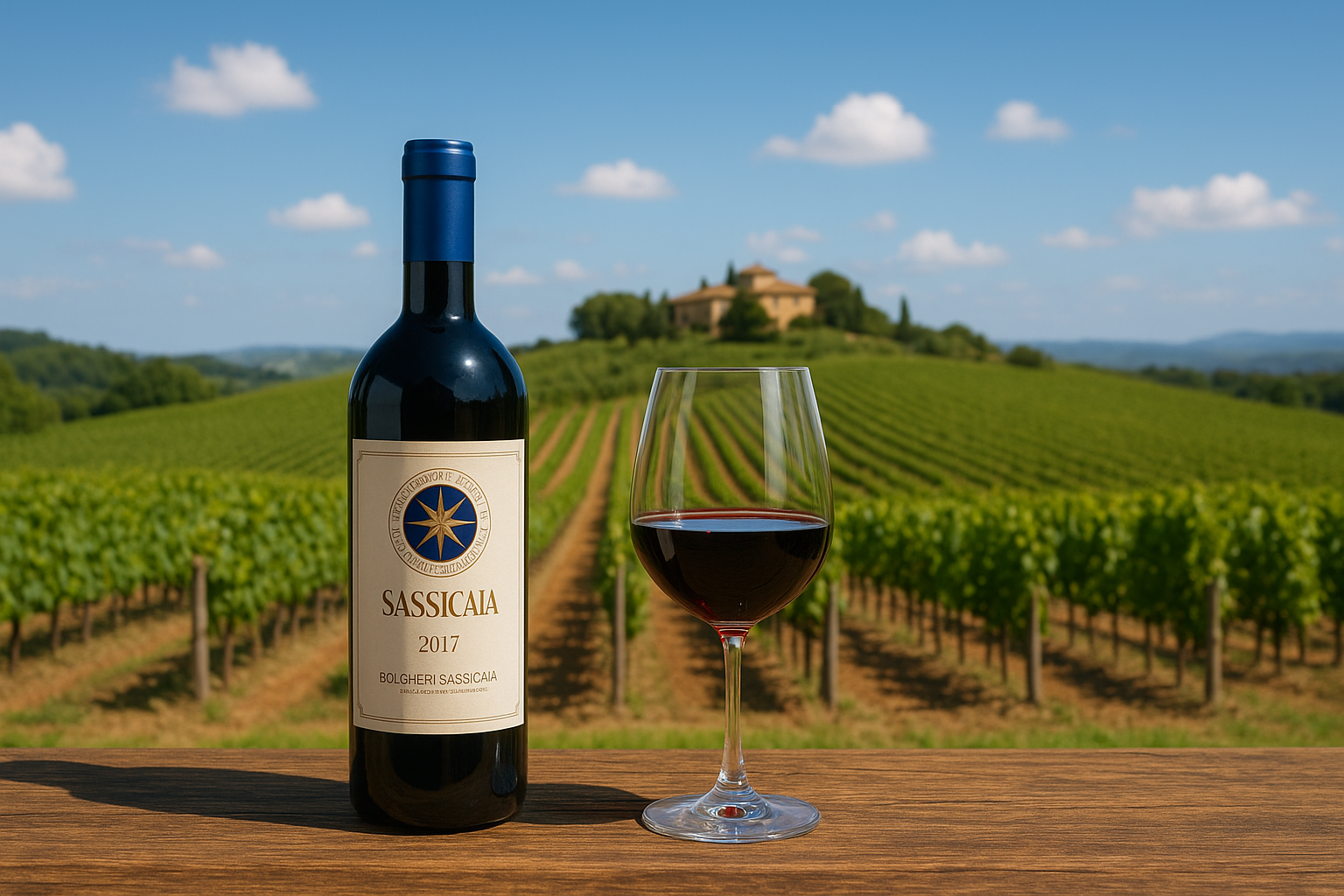
The Super Tuscan movement began quietly in 1944 when Marchese Mario Incisa della Rocchetta planted Cabernet Sauvignon cuttings from Château Lafite Rothschild on his coastal Bolgheri estate. He wanted to create a Bordeaux-style wine for personal consumption, never imagining that his experiment would reshape Italian winemaking entirely. The resulting wine, Sassicaia, remained a family secret for decades, shared only with friends and relatives who recognized its exceptional quality. This private project planted the seed for what would become Italy’s most revolutionary wine category.
Sassicaia: The first rebel
Sassicaia finally reached the market in 1968, though limited quantities had been released commercially in the late 1960s. The wine shocked critics and consumers alike because nothing in Italy tasted remotely similar. It featured 100% Cabernet Sauvignon from gravelly Bolgheri soils, aged in French barriques, creating a wine that resembled Bordeaux more than any traditional Tuscan red. Wine writer Luigi Veronelli championed the wine from its earliest releases, but the 1972 vintage truly announced Sassicaia’s arrival when a blind tasting in London placed it ahead of prestigious Bordeaux châteaux. You can trace every Super Tuscan back to this single estate’s willingness to ignore convention.
"Sassicaia proved that Tuscan terroir could produce world-class wines without following DOC regulations or relying primarily on Sangiovese."
Tignanello breaks through commercially
Antinori released Tignanello in 1971, and this wine democratized the Super Tuscan concept by coming from Chianti Classico’s heartland rather than coastal Bolgheri. Piero Antinori blended 80% Sangiovese with Cabernet Sauvignon and Cabernet Franc, eliminated white grapes entirely, and aged the wine in French oak. Tignanello became commercially successful almost immediately, proving that collectors would pay premium prices for wines labeled Vino da Tavola if quality justified the cost. The wine’s accessibility compared to rare Sassicaia meant more people experienced what Super Tuscan wine offered, spreading enthusiasm for this new category throughout international markets.
Recognition and the IGT category
Italian authorities created the Indicazione Geografica Tipica (IGT) classification in 1992, finally acknowledging that innovative wines deserved recognition beyond Vino da Tavola status. This new category allowed producers to specify geographic origins and grape varieties on labels while maintaining freedom to experiment outside DOC constraints. Many Super Tuscans now carry the IGT Toscana designation, though some prestigious bottles like Sassicaia earned their own dedicated DOC Bolgheri Sassicaia in 1994, a rare honor recognizing a single wine’s historical importance in defining what is Super Tuscan wine today.
Grapes, blends, and the main Super Tuscan styles
Understanding what is Super Tuscan wine requires recognizing that this category encompasses diverse blending approaches rather than a single formula. Producers essentially work with two main strategies: elevating Sangiovese by blending it with international varieties, or creating pure Bordeaux-style blends that eliminate Sangiovese entirely. Both approaches break traditional DOC rules, but they produce distinctly different wine profiles that appeal to different palates and pairing preferences. Your choice between these styles depends on whether you prefer wines that maintain Tuscan character or those that taste closer to classic Bordeaux.
Sangiovese-based Super Tuscans
Wines like Tignanello demonstrate how Cabernet Sauvignon and Cabernet Franc enhance Sangiovese’s natural qualities without overwhelming its bright cherry fruit and savory herbal notes. These blends typically contain 60-80% Sangiovese, with international varieties adding structure, depth, and aging potential that pure Sangiovese sometimes lacks. Producers choose this approach when they want wines that still taste unmistakably Tuscan while gaining the tannic backbone and complexity that Bordeaux varieties provide. You’ll recognize these wines by their balance between Sangiovese’s acidity and the richer, darker fruit that Cabernet contributes.
"Sangiovese-based Super Tuscans bridge tradition and innovation, maintaining Tuscan identity while incorporating international varieties for enhanced structure."
Other producers blend Sangiovese with Merlot instead of Cabernet, creating softer, more immediately approachable wines. Merlot adds plush texture and red fruit flavors that complement Sangiovese’s brightness without the firm tannins that Cabernet brings. Some winemakers even experiment with Syrah or other varieties, though these remain less common in classic Super Tuscan blends.
Bordeaux-blend Super Tuscans
Sassicaia pioneered the pure Bordeaux approach, and wines like Ornellaia continue this tradition by using 100% international varieties grown in Tuscan soil. These blends typically combine Cabernet Sauvignon with Merlot, Cabernet Franc, and sometimes Petit Verdot in proportions similar to Left Bank Bordeaux. Producers choose this style when they believe Tuscan terroir can express Bordeaux varieties better than traditional Sangiovese formulas. You’ll find these wines taste more like high-end Bordeaux than anything traditionally Italian, with dense black fruit, structured tannins, and remarkable aging potential.
Regional variations across Tuscany
Coastal Bolgheri produces the most Bordeaux-like Super Tuscans because maritime influence and gravelly soils favor Cabernet Sauvignon particularly well. Chianti Classico’s higher-elevation vineyards tend toward Sangiovese-dominant blends that maintain regional character while incorporating international varieties. Maremma’s warmer southern areas allow Merlot to ripen fully, creating softer, more fruit-forward styles. Your experience with Super Tuscan wine changes significantly based on which Tuscan subregion produced the bottle.
What Super Tuscan wine tastes like
Describing what is Super Tuscan wine in terms of flavor requires acknowledging that no single taste profile applies across the category. Your experience depends entirely on whether you’re drinking a Sangiovese-based blend or a pure Bordeaux-style wine, and which specific Tuscan subregion produced the grapes. However, all Super Tuscans share certain qualities: concentrated fruit intensity, substantial tannin structure, and complexity that develops beautifully with age. You’ll notice these wines feel richer and fuller-bodied than traditional Chianti, with deeper color and more pronounced oak influence from barrel aging in French barriques.
Sangiovese-dominant blends
When you taste Super Tuscans built primarily on Sangiovese, you’ll encounter bright cherry and raspberry flavors at the core, typical of this grape variety. The addition of Cabernet Sauvignon or Merlot adds layers of blackberry, cassis, and darker fruit that deepen the flavor profile without erasing Sangiovese’s characteristic acidity and savory herbal notes. You might detect dried herbs, tobacco, leather, and earthy minerality that connect these wines to traditional Tuscan reds. The tannins feel firmer and more structured than pure Sangiovese wines, providing the backbone needed for extended cellaring while maintaining the food-friendly acidity that makes Italian reds such versatile pairing partners with dishes like our 16oz Ribeye or homemade pasta.
"Sangiovese-based Super Tuscans maintain Tuscan brightness while gaining depth and structure from international varieties."
Pure Bordeaux blend characteristics
Wines made entirely from Cabernet Sauvignon, Merlot, and Cabernet Franc taste substantially different from Sangiovese blends. You’ll find dense black fruit flavors like blackcurrant, plum, and black cherry dominating the palate, with less of the bright red fruit and high acidity typical of Sangiovese. These wines show pronounced oak influence through vanilla, toast, cedar, and sweet spice notes that come from new French barrels. The texture feels richer and more velvety, especially in Merlot-forward blends, while Cabernet-dominant wines deliver firm, structured tannins that require aging to soften. You might easily mistake a blind tasting of these wines for high-end Bordeaux, though Tuscan sunshine typically provides riper fruit character than Bordeaux’s cooler climate allows.
Aging transforms the profile
Young Super Tuscans taste bold and somewhat closed, with aggressive tannins and primary fruit dominating. After five to ten years, you’ll notice the wine evolves into something more complex, with fruit flavors integrating with savory notes of leather, cigar box, truffle, and dried flowers. The tannins soften substantially, creating a silky texture that showcases why collectors age these wines.
How to identify Super Tuscan wine on a label
Walking into a wine shop or reviewing a restaurant list like ours at La Dolce Vita Cucina, you need practical strategies for spotting Super Tuscan bottles among hundreds of Italian wines. These wines don’t announce themselves with obvious appellations like Chianti Classico or Brunello di Montalcino. Instead, you’ll find seemingly humble classifications that contradict the premium prices and exceptional quality inside the bottle. Learning to recognize the specific label indicators helps you identify these wines quickly and understand what is Super Tuscan wine when you’re making purchasing decisions.
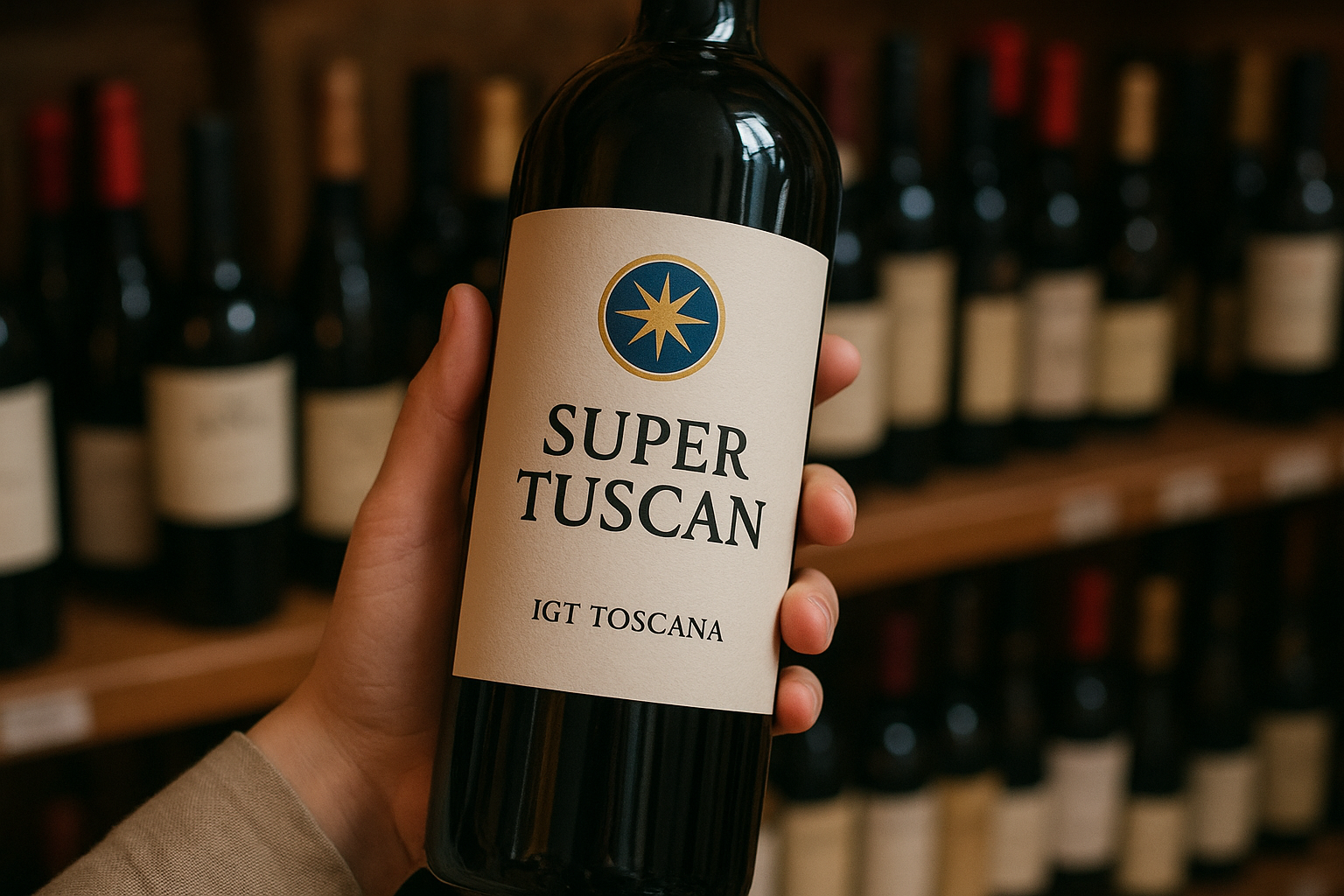
Look for IGT Toscana or Vino da Tavola designations
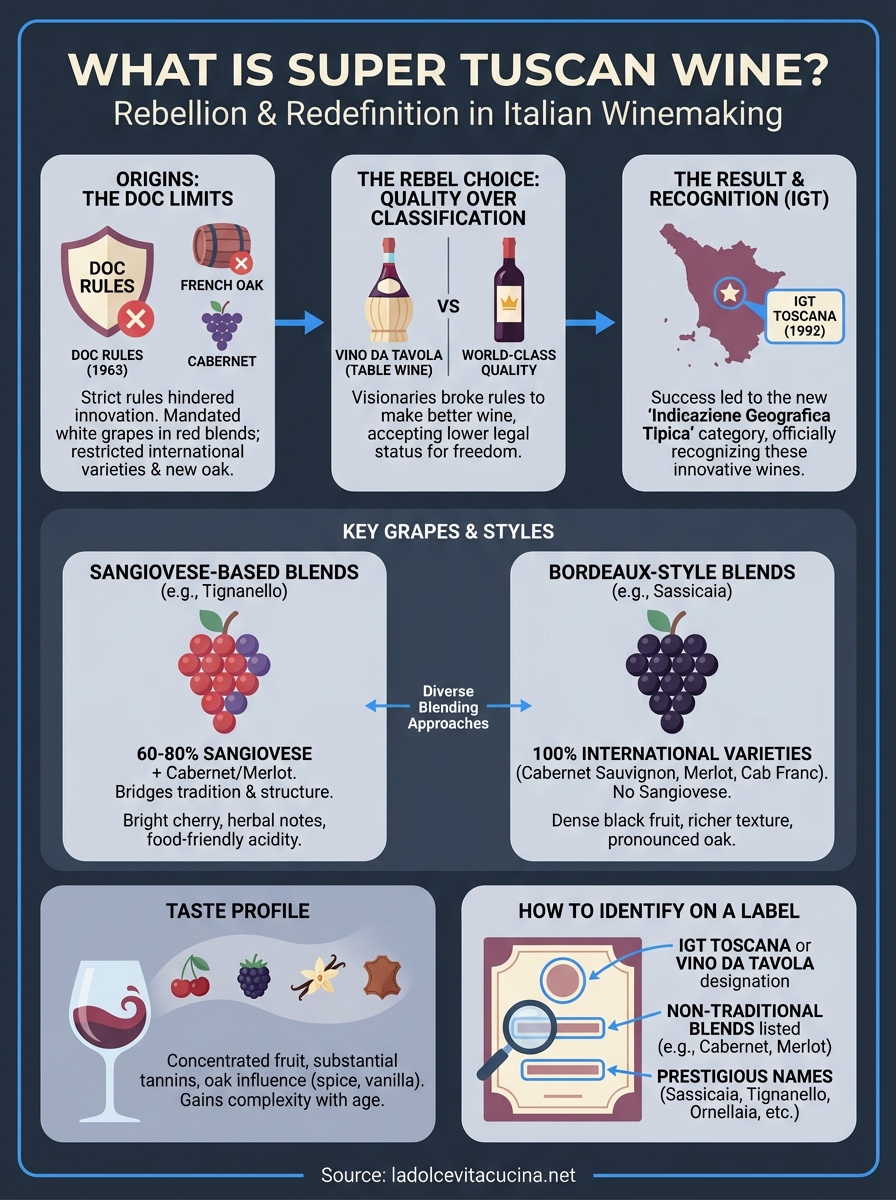
You’ll find most modern Super Tuscans carry the IGT Toscana classification on their labels, which stands for Indicazione Geografica Tipica Toscana. This designation tells you the wine comes from Tuscany but doesn’t conform to stricter DOC regulations that govern traditional appellations. Some historic bottles still proudly display Vino da Tavola, Italy’s basic table wine classification, because producers established their reputations before the IGT category existed in 1992. If you see either designation alongside a high price point and premium packaging, you’re likely looking at a Super Tuscan rather than an ordinary table wine.
"IGT Toscana or Vino da Tavola labels combined with premium pricing signal wines that chose innovation over traditional classification."
Check the grape varieties listed
Labels often list grape varieties, and you’ll spot Super Tuscans by their unconventional blends for Tuscany. Look for Cabernet Sauvignon, Merlot, or Cabernet Franc listed either alone or blended with Sangiovese. Traditional Tuscan DOC wines wouldn’t feature these international varieties so prominently. Some producers list exact percentages like "85% Cabernet Sauvignon, 15% Merlot," while others simply note the varieties without specific proportions. You won’t find mandatory white grapes like Trebbiano that older Chianti regulations required, another clear indicator you’re examining a Super Tuscan rather than a traditional classified wine.
Recognize prestigious producer names
Certain producers became synonymous with Super Tuscan excellence, and their names function as quality guarantees. You’ll identify Sassicaia, Tignanello, Ornellaia, Masseto, Solaia, and Guado al Tasso as benchmark examples that command collector interest worldwide. These names appear prominently on labels, often larger than the IGT designation. Smaller producers also make excellent Super Tuscans, but recognizing the historic pioneers helps you understand pricing structures and quality expectations within the category.
How it compares to Chianti, Brunello, and Bolgheri
Understanding what is Super Tuscan wine becomes clearer when you compare it directly to Tuscany’s traditional classified wines. Each classification represents different philosophies about winemaking, with Chianti Classico and Brunello di Montalcino following strict DOC and DOCG regulations while Super Tuscans deliberately work outside these frameworks. You’ll notice significant differences in grape composition, aging requirements, and flavor profiles across these categories, though all three originate from the same Tuscan landscape. The comparisons reveal why some producers chose freedom over official recognition and how regulatory structures shape the wines you taste.
Chianti Classico’s traditional approach
Chianti Classico requires minimum 80% Sangiovese under current regulations, with optional additions of other approved red grapes and historically mandated white varieties. You’ll find these wines taste brighter and more acidic than most Super Tuscans, with pronounced cherry fruit and herbal notes that reflect Sangiovese’s dominant presence. The aging happens primarily in large Slavonian oak casks rather than French barriques, creating wines with less obvious oak influence. Super Tuscans diverged from this formula by incorporating international varieties like Cabernet Sauvignon or eliminating Sangiovese entirely, producing wines with darker fruit, firmer tannins, and richer texture than traditional Chianti profiles allow.
"Chianti Classico maintains strict Sangiovese dominance while Super Tuscans embrace international blends for different structural goals."
Brunello di Montalcino’s single-variety focus
Brunello di Montalcino takes an opposite approach from Super Tuscans by requiring 100% Sangiovese Grosso, a local clone, with no international varieties permitted. These wines undergo lengthy aging periods mandated by DOCG regulations before release, developing complexity through time rather than blending. You’ll taste wines that showcase pure Sangiovese character with remarkable depth and aging potential, though they differ markedly from Super Tuscan profiles. Brunello producers work within strict boundaries to achieve excellence, while Super Tuscan makers rejected those same boundaries to explore different possibilities.
Bolgheri DOC wines versus Bolgheri Super Tuscans
Bolgheri received DOC status in 1994 specifically to accommodate Bordeaux-style wines that the region produces exceptionally well. You’ll find DOC Bolgheri wines use the same international grape varieties as Super Tuscans from the area, but they follow specific blending regulations and geographic boundaries. Some Bolgheri Super Tuscans like Sassicaia earned their own dedicated appellations, while others maintain IGT status despite meeting DOC requirements because producers prefer the flexibility and prestige their rebel classification carries.
Plan your next glass
You now understand what is Super Tuscan wine represents: a bold rejection of limiting regulations in pursuit of exceptional quality. These wines bridge Tuscan tradition with international influences, creating bottles that collectors worldwide seek for their complexity, aging potential, and remarkable expression of terroir. Your appreciation for Italian wine deepens when you recognize how these rebels transformed the entire category, proving that innovation sometimes requires stepping outside established rules.
At La Dolce Vita Cucina, we pour carefully selected Super Tuscans that pair beautifully with our authentic Italian cuisine. Whether you choose a Sangiovese-based blend alongside our homemade linguini or a Bordeaux-style wine with our 16oz Ribeye, experience these exceptional wines with dishes that honor the same Italian tradition that made Super Tuscans legendary. Your next glass awaits in Chicago’s Portage Park neighborhood, where quality and passion meet on every plate and in every bottle we serve.