
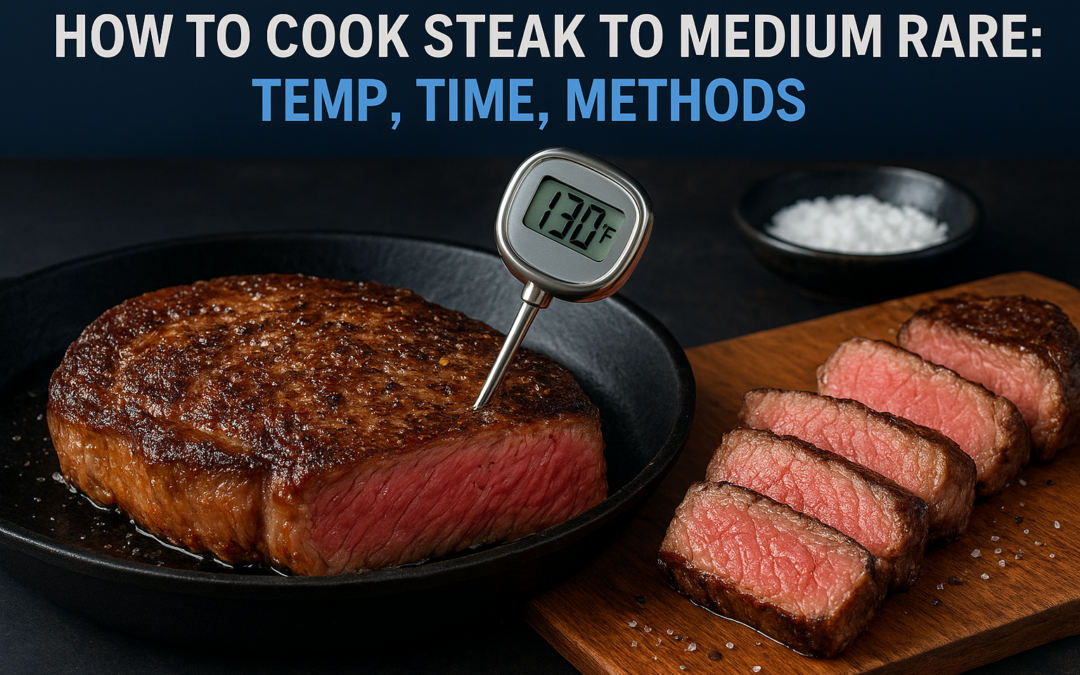
At La Dolce Vita Cucina, we sear steaks over high heat every night in our Portage Park kitchen, and the number one request from guests is medium rare. There’s a reason for that. A properly cooked medium-rare steak has a warm, red center that’s juicy and tender, with a crust that actually tastes like something. It’s the sweet spot where flavor and texture meet. So if you’ve ever searched how to cook steak to medium rare at home and ended up with something gray and chewy, you’re not alone.
The difference between a perfect medium rare and an overcooked disappointment comes down to a few specifics: internal temperature, timing, and method. Get those right, and you can produce restaurant-quality results on your own stovetop or grill. Get them wrong, and you’ve wasted a good piece of meat. It’s that straightforward, no guesswork required once you know the numbers.
This guide breaks down everything you need: the exact target temperature, how long to cook per side based on thickness, and the best methods, from pan-searing to grilling to oven-finishing. These are the same principles we follow when preparing our 16oz Ribeye at La Dolce Vita Cucina, and they’ll work just as well in your kitchen. Let’s get into it.
Medium rare targets, tools, and safety
Before you fire up any heat source, you need to know what you’re aiming for. Medium rare falls between 130°F and 135°F internal temperature, measured at the thickest part of the steak. Below 130°F, you’re in rare territory. Above 135°F, you’re heading toward medium, which means a firmer, less pink center. If you want to understand how to cook steak to medium rare consistently, the temperature target is non-negotiable. Guessing by touch or color alone is an unreliable method.
The exact temperature and doneness range
Different doneness levels have specific temperature bands, and knowing where medium rare sits within the full spectrum keeps you from overshooting. Here’s a quick reference:
| Doneness | Internal Temperature | Center Color |
|---|---|---|
| Rare | 120–125°F | Cool, bright red |
| Medium Rare | 130–135°F | Warm, red to pink |
| Medium | 140–145°F | Warm pink |
| Medium Well | 150–155°F | Slightly pink |
| Well Done | 160°F+ | Gray throughout |
Your target zone is 130–135°F, and you pull the steak off heat at around 128–130°F because carryover cooking adds 3 to 5 degrees during the rest. That window matters more than any other variable in the process.
Pull your steak off heat 3 to 5 degrees before your target temperature. Carryover cooking will finish the job during the rest.
The tools you actually need
You cannot hit a precise temperature without a way to measure it. An instant-read thermometer is the single most important tool for cooking steak accurately, and a reliable one runs around $25 to $35. Insert it into the thickest part of the steak, away from bone or fat, for an accurate reading. A cast iron skillet or heavy stainless steel pan is the best option for stovetop cooking because it holds heat evenly and produces a strong sear.
- Instant-read thermometer (accurate to within 1 to 2 degrees)
- Cast iron skillet or heavy stainless steel pan
- Tongs (not a fork, which pierces the meat and releases juices)
- Wire rack and sheet pan if you plan to finish in the oven
What you should know about food safety
The USDA recommends cooking whole muscle beef steaks to a minimum of 145°F with a three-minute rest, which technically lands in medium territory. That standard exists to provide a universal safety margin. For whole cuts of beef like steaks, pathogens live on the surface, and those surface temperatures reach far above 145°F during a proper sear, which is why 130–135°F is widely accepted by food scientists as safe for most people.
If you are cooking for immunocompromised individuals, pregnant women, or young children, follow the USDA guideline of 145°F. For healthy adults, medium rare is a choice that restaurants serve every single night.
Step 1. Pick the right cut and thickness
Not every steak cooks the same way, and the cut you choose directly affects how easy it is to hit medium rare. Thicker cuts with good marbling give you more control over the process, while thin cuts cook so fast that you can overshoot your target temperature in seconds. Choosing the right starting point makes everything that follows much simpler.
Best cuts for medium rare
Ribeye, New York strip, and filet mignon are the top choices for medium rare because they have the right fat content and muscle structure. Ribeye brings the most marbling and is the most forgiving cut to cook. Filet mignon is the most tender cut on the animal, and medium rare is the only doneness level that does it justice.
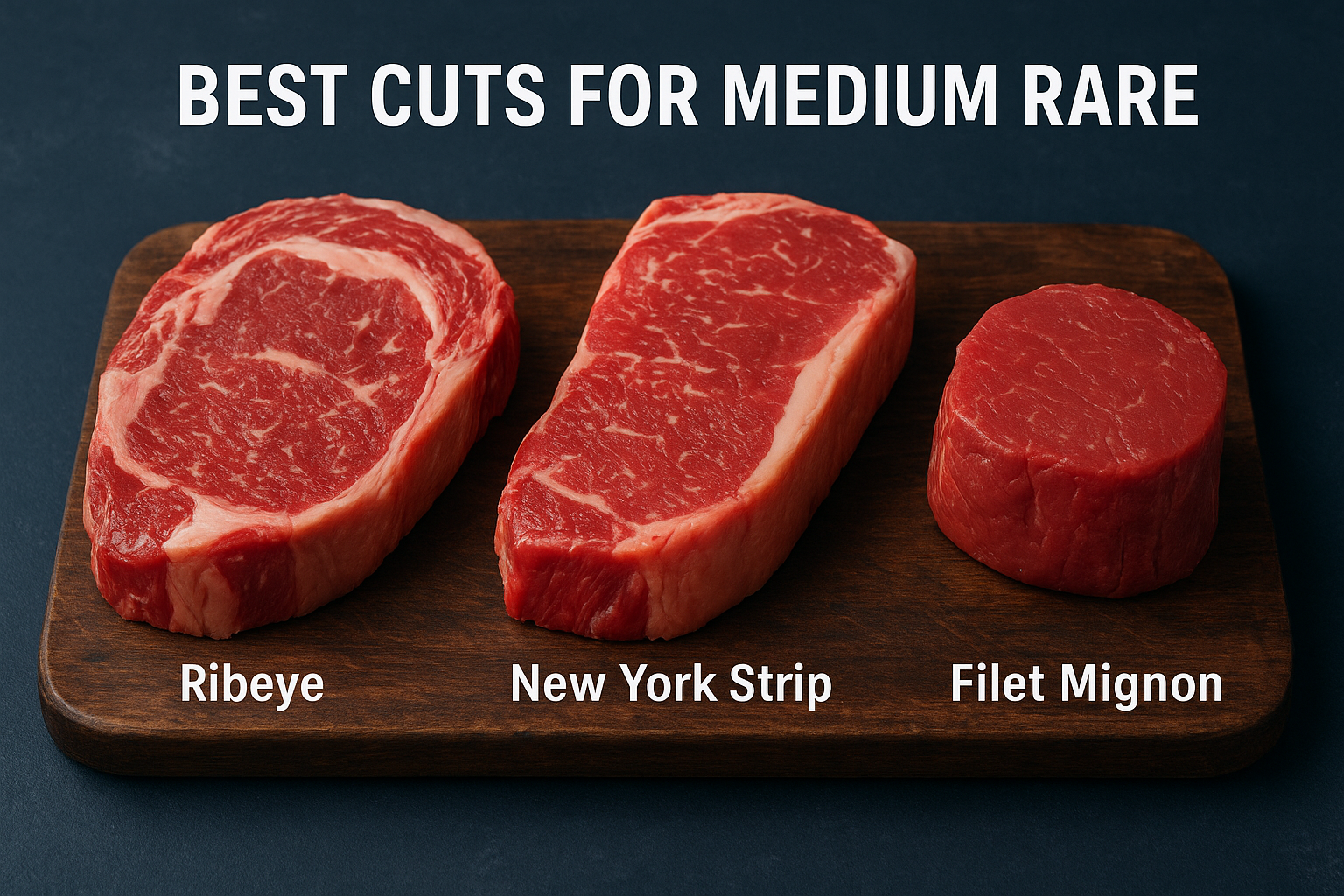
If you want to understand how to cook steak to medium rare with the least margin for error, start with a ribeye at least 1 inch thick.
- Ribeye: High marbling, bold flavor, very forgiving
- New York Strip: Leaner, firm texture, great crust potential
- Filet Mignon: Most tender, mild flavor, needs precise timing
- T-Bone or Porterhouse: Two cuts in one, slightly more complex to cook evenly
Why thickness matters
Aim for a steak that is at least 1 inch thick, and ideally 1.25 to 1.5 inches. Thinner steaks reach their internal temperature before the exterior has time to build a proper crust. A thicker cut gives you the window to sear the outside while the center climbs to 130–135°F gradually.
Anything under 3/4 of an inch is hard to control regardless of method. By the time you have a proper sear, the center is already overcooked. If your butcher only has thin cuts, ask them to cut to order.
Step 2. Prep and season for a great sear
Good prep work determines whether your steak builds a real crust or just steams in the pan. Before you apply any heat, two things need to happen: the surface of the meat needs to be completely dry, and the seasoning needs time to penetrate. Skipping either step costs you the sear, and without the sear, you lose the flavor that makes a great medium-rare steak worth eating.
Dry the surface before applying heat
Moisture is the enemy of a good crust. When a wet steak hits a hot pan, surface water evaporates first, which drops the pan temperature and delays browning. Pull your steak from the refrigerator 30 to 45 minutes before cooking, which lets it lose some chill and dry out slightly at room temperature. Then pat every surface firmly with paper towels until the steak feels almost tacky to the touch.
A dry surface is what gives you that deep, caramelized crust. No moisture, no steam, no gray exterior.
Season simply and season generously
Knowing how to cook steak to medium rare starts well before the pan gets hot. Kosher salt and freshly cracked black pepper are all you need for seasoning, and you need more of both than you think. The salt draws out a small amount of moisture and then gets reabsorbed, which seasons the meat below the surface. Apply a generous, even coat on all sides, including the edges, and let the steak sit uncovered on a wire rack for at least 20 minutes so the salt can penetrate properly.
- Kosher salt: approximately 1 teaspoon per pound of meat
- Black pepper: crack it coarse and coat evenly
- Optional: garlic powder or smoked paprika for added depth
- Skip wet marinades before searing; they add surface moisture and prevent browning
Step 3. Cook by method and hit 130–135°F
Once your steak is dry, seasoned, and close to room temperature, you’re ready to apply heat. The method you choose depends on the equipment you have available, but all three approaches below can help you understand how to cook steak to medium rare with real precision. Your thermometer is the final judge, not the timer.
Pan-Sear on the Stovetop
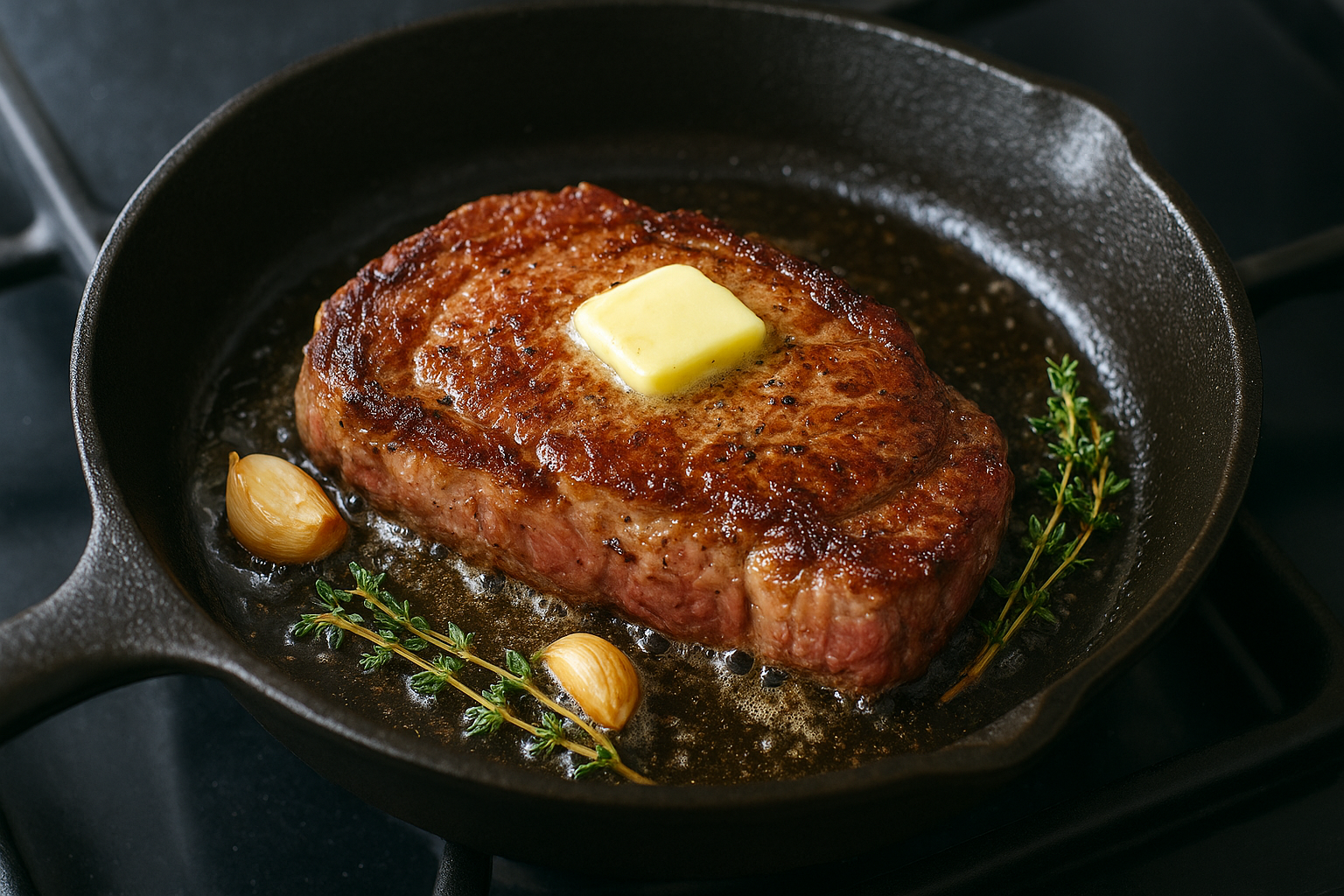
Get your cast iron skillet screaming hot over high heat before the steak touches the surface. Add a high smoke-point oil like avocado or grapeseed oil, let it shimmer, then lay the steak away from you. Sear each side for 2 to 3 minutes for a 1-inch steak, then hold the edges against the pan for 30 seconds each. Baste with butter, garlic, and thyme in the final minute.
| Steak Thickness | Time Per Side | Pull Temperature |
|---|---|---|
| 1 inch | 2 to 3 minutes | 128°F |
| 1.25 inches | 3 to 4 minutes | 128°F |
| 1.5 inches | 4 to 5 minutes | 128°F |
Grilling
Preheat your grill to high heat, around 450 to 500°F, and clean the grates before placing the steak down. Use the same timing as pan-searing, flipping once and checking temperature frequently after the first flip. Keep the lid closed between flips to hold ambient heat and push the internal temperature upward steadily.
For thicker cuts on the grill, move the steak to a cooler zone after searing to finish the center without scorching the exterior.
Reverse Sear for Thick Cuts
Place your steak on a wire rack over a sheet pan and bake it at 250°F until the internal temperature hits 115°F, which typically takes 45 to 60 minutes for a 1.5-inch steak. Then sear it in a ripping-hot cast iron skillet for 60 to 90 seconds per side to lock in a crust. This method delivers the most even doneness from edge to edge.
- Oven temp: 250°F
- Pull from oven at: 115°F internal
- Final sear: 60 to 90 seconds per side in cast iron
- Total time: roughly 60 to 70 minutes including the sear
Step 4. Rest, slice, and serve
You pulled the steak off heat at 128–130°F, and now the most common mistake people make is cutting into it immediately. Resist that. The rest period is where carryover cooking finishes the job, pushing the internal temperature up to your 130–135°F target while the juices redistribute back through the muscle fibers. Skip this step, and those juices run straight onto your cutting board instead of staying in the meat.
How long to rest your steak
Rest time scales with the thickness of your steak. A 1-inch cut needs at least 5 minutes; a 1.5-inch cut benefits from 7 to 10 minutes. Tent the steak loosely with foil to hold warmth without trapping steam, which would soften the crust you worked to build. Do not wrap it tightly, and do not place it in a warm oven during this time.
Resting is not optional. It is the final step in how to cook steak to medium rare correctly, and cutting early means losing the juice that makes it worth eating.
- 1-inch steak: rest 5 minutes
- 1.25-inch steak: rest 6 to 7 minutes
- 1.5-inch steak: rest 8 to 10 minutes
How to slice for maximum tenderness
Once rested, always cut against the grain. Look at the muscle fibers running along the surface of the steak and slice perpendicular to them. This shortens the fibers in each bite, which makes the steak feel significantly more tender than it would if you cut with the grain. For cuts like ribeye or strip, a sharp slicing knife held at a slight angle produces the cleanest result. Plate immediately after slicing and finish with a small pat of compound butter or fresh herbs if you want a restaurant-style presentation.
Your medium-rare steak, every time
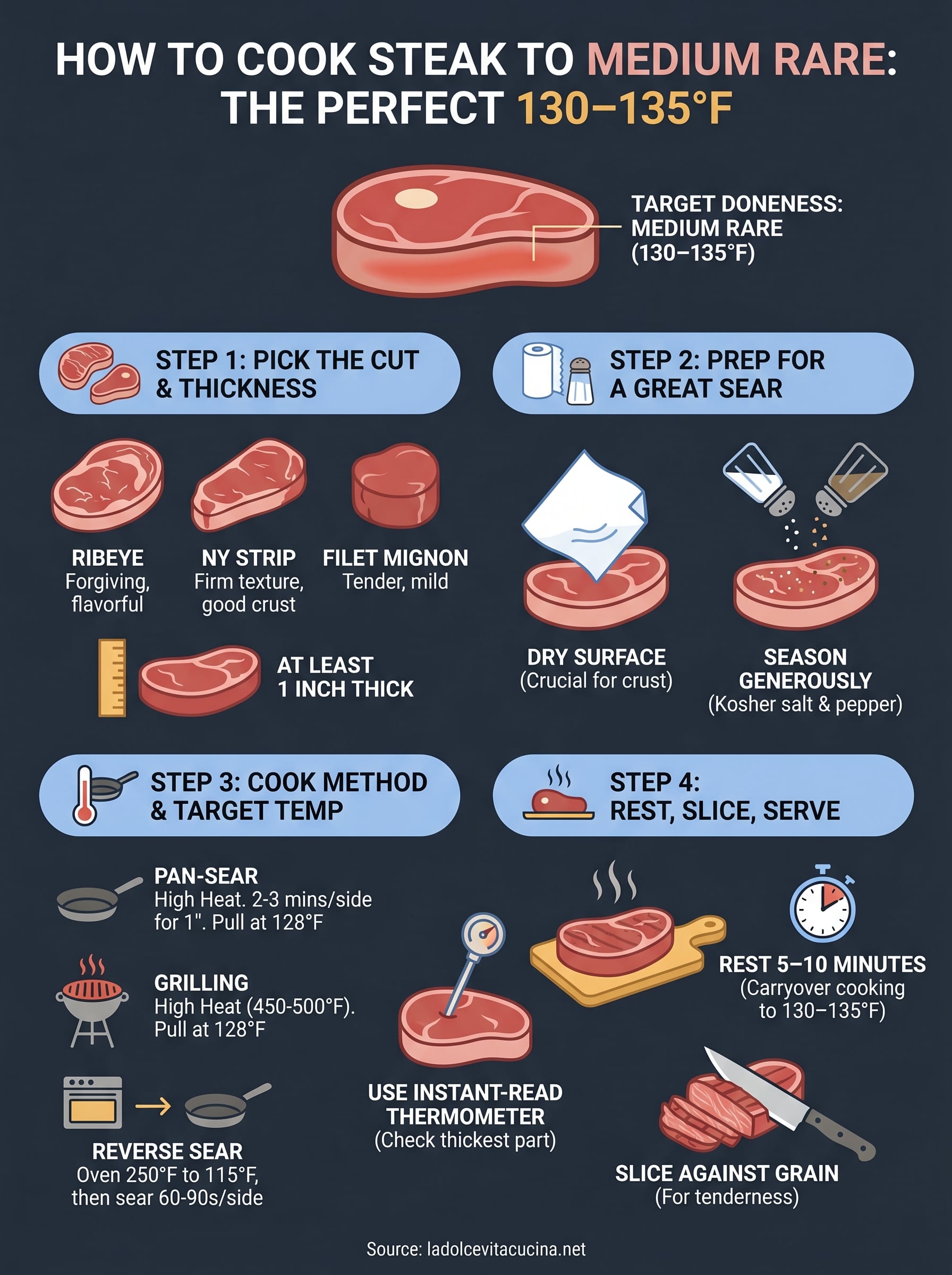
Now you have everything you need to know about how to cook steak to medium rare: the right cut, a dry and seasoned surface, a precise temperature target of 130–135°F, and a proper rest before slicing. Each step builds on the last, and skipping any one of them shows up on the plate. Your thermometer does the guesswork for you, so use it every time without exception.
Practice these steps starting with a ribeye first. It is the most forgiving cut, and once you nail the timing and temperature on that, every other steak becomes easier. Consistent results come from consistent process, not from luck or instinct. Follow the method, trust the numbers, and you will have a steak worth eating every single time.
Ready to see what medium rare looks like when a professional kitchen handles the sear? Come try our 16oz Ribeye at La Dolce Vita Cucina in Chicago’s Portage Park neighborhood.