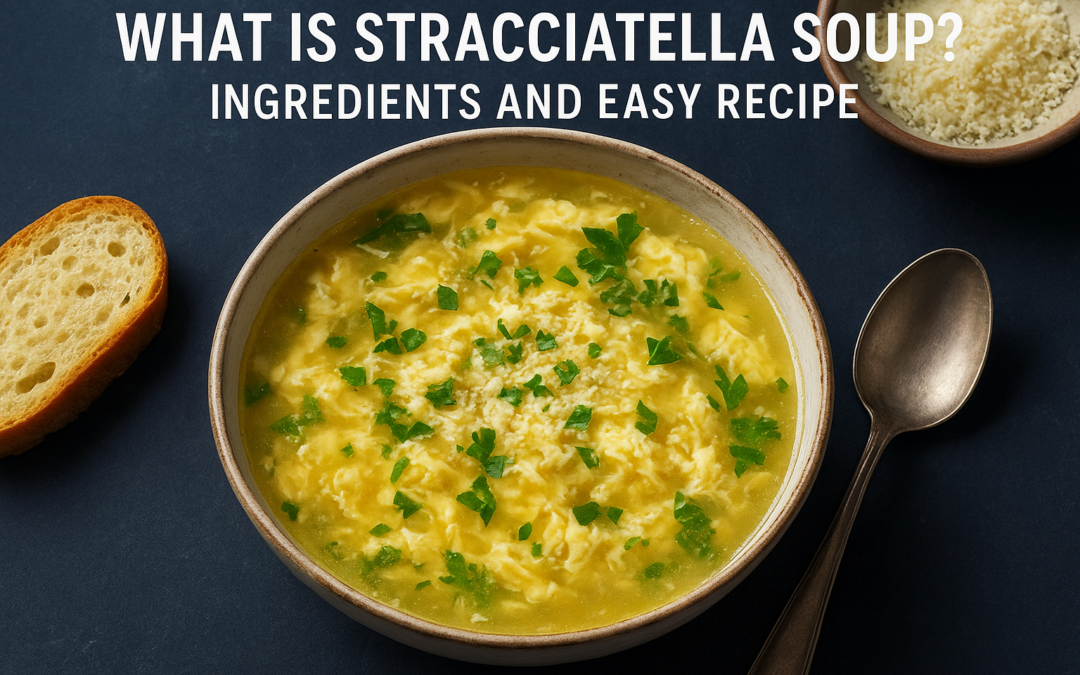
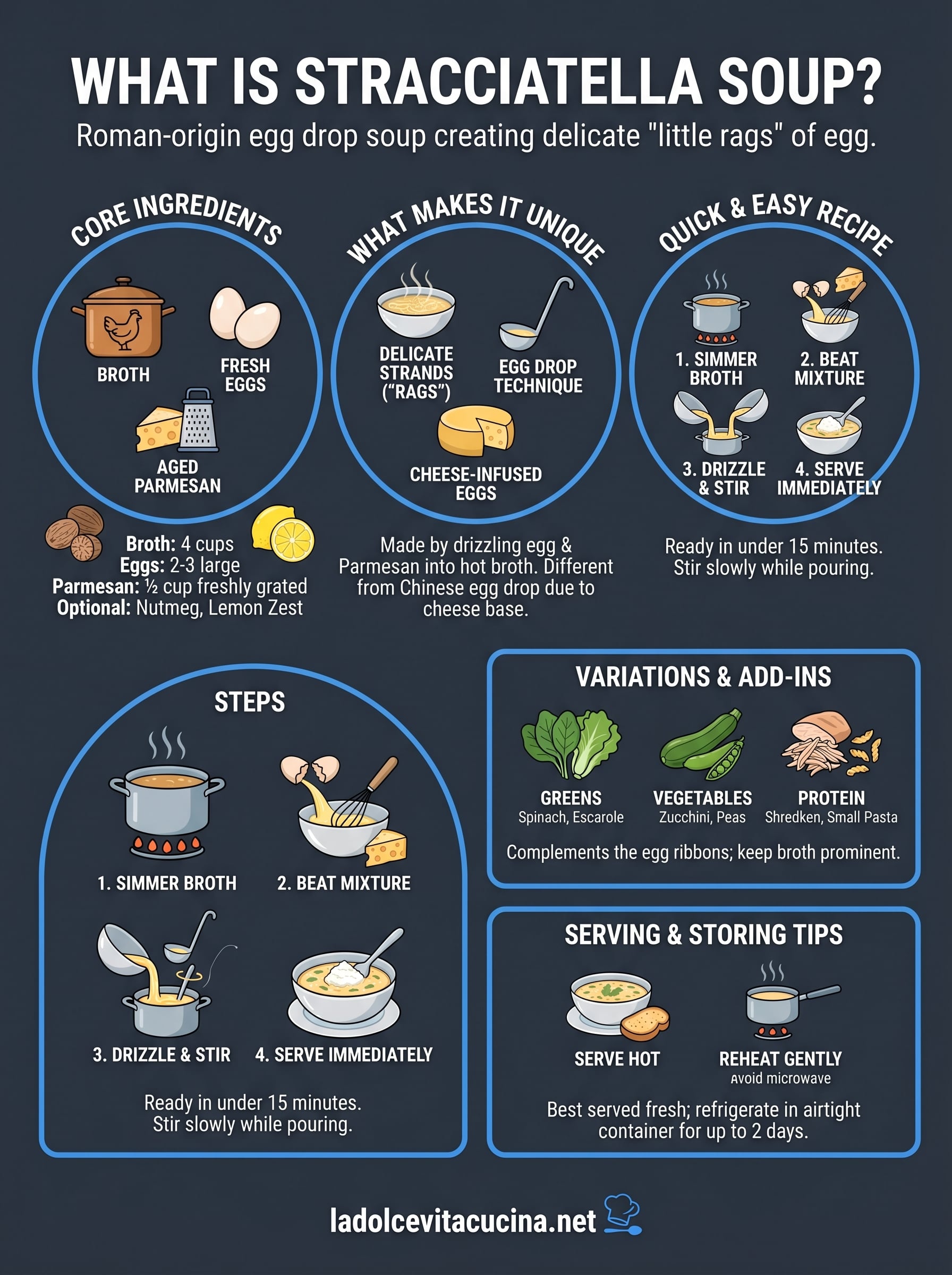
If you’ve ever wondered what is stracciatella soup, the answer is one of Italy’s most comforting and surprisingly simple dishes. It’s a Roman-origin egg drop soup made by whisking beaten eggs and Parmesan cheese into a pot of hot broth, creating delicate, ragged strands, which is exactly what "stracciatella" means: "little rags." The result is a bowl that’s light, savory, and deeply satisfying.
At La Dolce Vita Cucina in Chicago’s Portage Park neighborhood, we built our kitchen around this kind of Italian cooking, dishes that don’t hide behind complexity but instead rely on quality ingredients and proper technique. Stracciatella soup is a perfect example of that philosophy, and it’s one of those recipes every home cook should have in their back pocket.
Below, we’ll break down the history of stracciatella soup, walk through every ingredient you need, and give you a straightforward recipe you can pull off on a weeknight. We’ll also cover common mistakes, useful variations, and a few tips we’ve picked up from years of making Italian food in our own kitchen.
What stracciatella soup is and why it’s unique
When someone asks what is stracciatella soup, the simplest answer is a broth-based Italian soup made by drizzling a mixture of beaten eggs and Parmesan cheese into simmering stock while stirring quickly to create thin, wispy strands. Those strands give the dish its name. "Stracciatella" comes from the Italian word stracciare, meaning "to shred" or "to tear," which describes precisely what the egg does as it sets in the hot liquid. The result is a bowl that’s light and savory at the same time, with a delicate texture unlike anything else in Italian cooking. You need only a handful of ingredients, and the whole thing comes together in minutes.
The Roman origins of stracciatella soup
This soup traces its roots to Lazio, the central Italian region where Rome sits. Historians and Italian food writers widely place its origin in Roman home kitchens, where cooks made the most of simple pantry staples. The technique itself is ancient: you beat eggs with cheese, sometimes adding a touch of nutmeg or lemon zest, then pour the mixture into hot broth while stirring in slow circular motions. The eggs cook almost immediately, forming those signature ragged ribbons throughout the liquid. Roman families traditionally served this soup during cold months and on feast days, treating it as both a restorative and a first-course dish that signaled the start of something worth sitting down for.
Stracciatella soup became so connected to Roman cooking that it eventually earned the informal label "stracciatella alla romana," distinguishing it from other regional egg-based variations across Italy.
Why stracciatella stands apart from other egg soups
Many cultures have their own version of egg drop soup, but stracciatella sets itself apart through two specific elements: the cheese and the broth quality. Chinese egg drop soup uses water or a light stock with no cheese. French egg-based soups follow entirely different flavor profiles. Italian stracciatella relies on aged Parmesan or Pecorino Romano to add both saltiness and body to the egg mixture before it even contacts the pot. That single step changes the flavor completely, giving you something that tastes unmistakably Italian from the first spoonful.
The broth matters just as much as the eggs themselves. In Rome, homemade beef or chicken broth is the standard base, and it carries the whole dish. A thin, watery stock will produce a thin, forgettable bowl. A rich, well-seasoned broth lets the egg ribbons take center stage and deliver the depth this soup is known for. That balance between a full-flavored liquid and those delicate strands is what makes stracciatella deeply satisfying without being heavy. You don’t need an elaborate ingredient list to pull this off, but you do need to take the broth seriously, because it does the majority of the work.
Key ingredients and smart substitutions
Understanding what is stracciatella soup really comes down to its ingredient list. The dish works because each component has a specific job, and skipping or downgrading any one of them shows up immediately in the bowl. You need quality broth, fresh eggs, and aged cheese at minimum, and everything else is optional.
The core ingredients you need
The foundation is good broth, and chicken broth is the most common choice for home cooks. Beef broth is the more traditional Roman option and gives you a deeper, richer flavor. You’ll also need 2 to 3 large eggs per serving, freshly grated Parmesan cheese, a pinch of salt, and optionally a small grating of fresh nutmeg or a squeeze of lemon juice. Those last two additions are minor, but they lift the whole bowl.
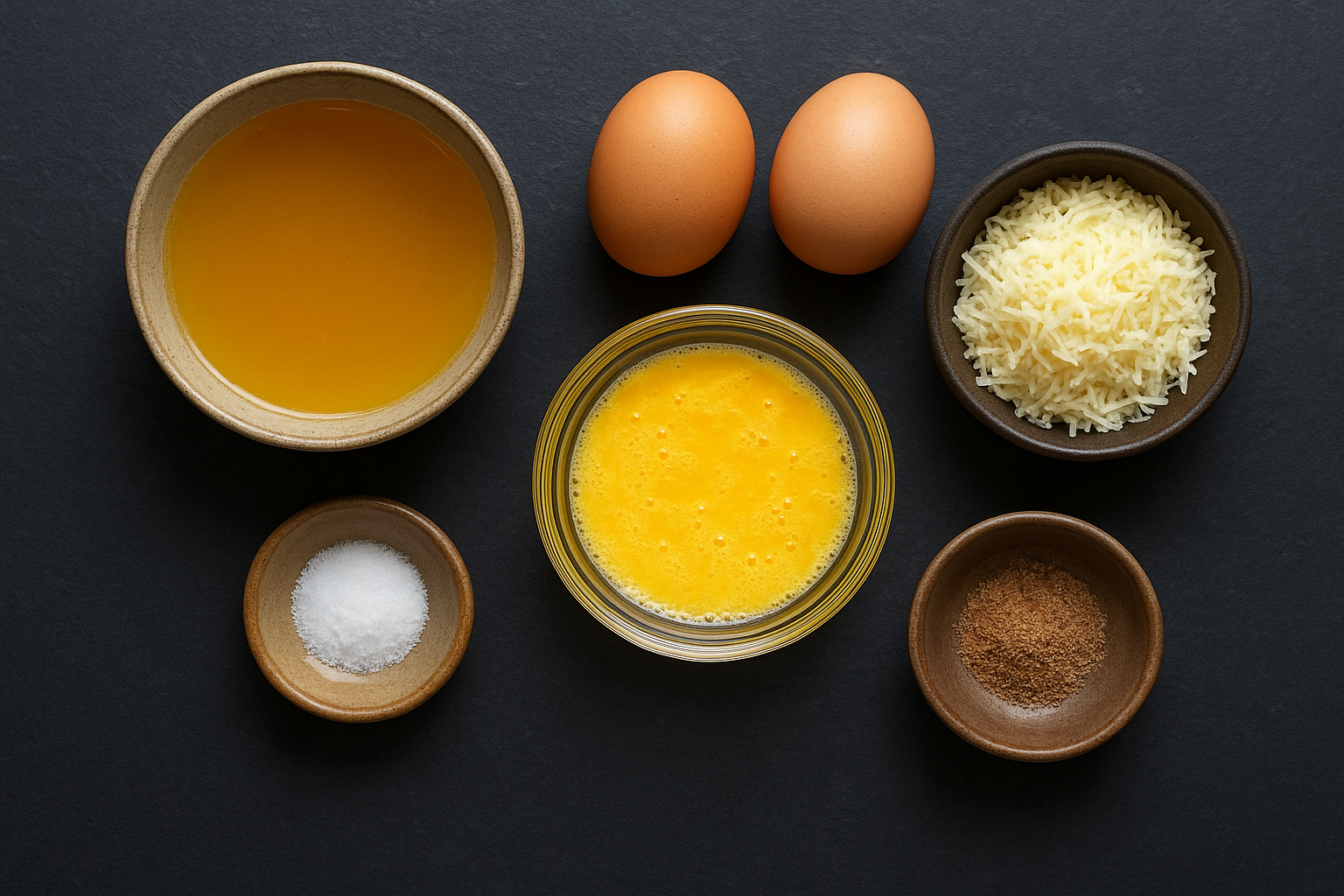
- Broth: 4 cups chicken or beef broth per 2 servings
- Eggs: 2 to 3 large eggs, beaten
- Parmesan: ½ cup freshly grated, not pre-shredded
- Salt and pepper: to taste
- Nutmeg or lemon zest: optional but recommended
Fresh block Parmesan grated by hand melts into the egg mixture far more smoothly than pre-shredded cheese, which contains anti-caking agents that cause the strands to clump together in the pot.
Smart substitutions that still work
Sometimes you can’t get every ingredient on the list, and a few swaps hold up well without wrecking the dish. Pecorino Romano works in place of Parmesan and gives you a slightly sharper, saltier result. If you’re out of fresh eggs, liquid whole eggs from a carton work in a pinch, though fresh eggs produce better ribbons.
| Original | Substitution | Notes |
|---|---|---|
| Parmesan | Pecorino Romano | Saltier, sharper flavor |
| Chicken broth | Vegetable broth | Lighter, works for vegetarians |
| Beef broth | Chicken broth | Slightly lighter result |
| Fresh nutmeg | Ground nutmeg | Use half the amount |
Easy stracciatella soup recipe step-by-step
Now that you know what is stracciatella soup and have your ingredients ready, the actual cooking process is fast. From start to finish, this recipe takes under 15 minutes, making it one of the most practical Italian dishes you can add to your weeknight rotation. The only real skill involved is controlling the speed of your egg pour and the temperature of your broth.
What you need before you start
Before you touch the stove, get everything measured and prepped. Cold eggs won’t blend smoothly, and scrambling to grate cheese while your broth boils over is exactly how this soup goes wrong. Set out your bowl, your grater, and your ladle before you turn on the heat.
- 4 cups good-quality chicken or beef broth
- 3 large eggs
- ½ cup freshly grated Parmesan
- Salt and black pepper to taste
- Optional: pinch of nutmeg or ½ teaspoon lemon zest
How to make it
The steps are simple, but your pouring technique makes or breaks the egg ribbons. Drizzle the egg mixture in slowly while stirring the broth in a steady circular motion. Pouring too fast produces chunks instead of the delicate strands this soup is known for.
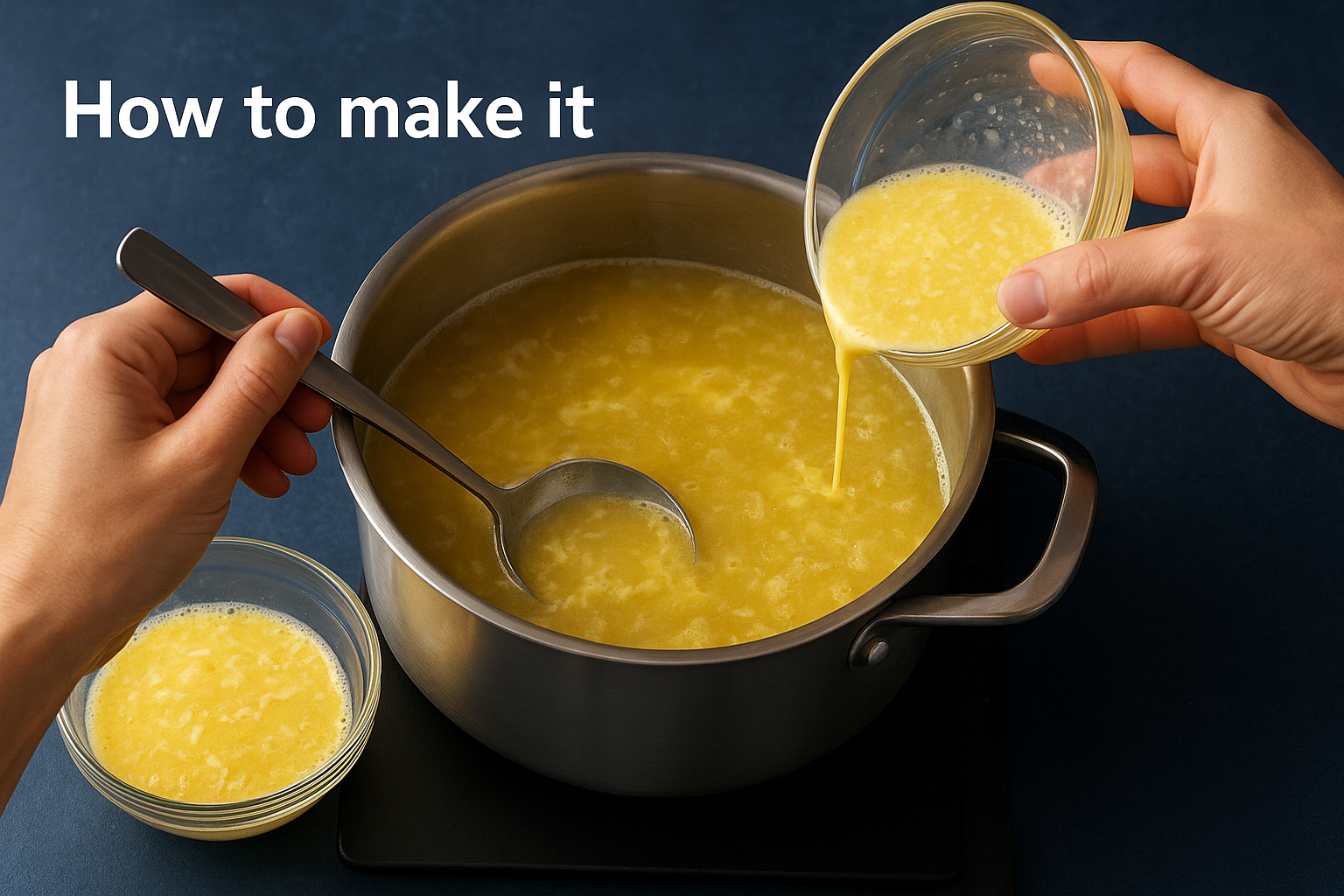
Keep your broth at a gentle simmer, not a rolling boil, when you add the egg mixture. Too much heat causes the eggs to seize and clump before they can form ribbons.
Step-by-step instructions:
- Bring broth to a gentle simmer over medium heat in a medium saucepan.
- In a bowl, beat eggs with Parmesan, salt, pepper, and nutmeg until fully combined.
- Use a fork or spoon to stir the broth in slow circular motions.
- Slowly drizzle the egg mixture into the moving broth in a thin, steady stream.
- Continue stirring for 30 to 60 seconds until all the egg strands have set.
- Ladle into bowls and top with extra Parmesan if you like.
Variations and add-ins that still taste Italian
Once you understand what is stracciatella soup at its core, you can build on it without losing what makes it Italian. The base recipe is intentionally minimal, which means it handles extra ingredients well as long as you keep the broth front and center and avoid overcrowding the pot. Every addition below works because it complements the egg ribbons rather than competing with them.
Greens and vegetables that fit right in
Leafy greens are the most traditional variation you’ll find across Italian home kitchens. Spinach and escarole are the two most common choices. Add a handful of fresh baby spinach or roughly torn escarole directly to the simmering broth before you pour in the egg mixture. The greens wilt in under a minute and add color, texture, and a mild bitterness that balances the richness of the eggs and cheese.
Adding greens to the broth before the eggs lets everything cook at the right pace without overcomplicating the timing.
Other vegetables that work well without changing the character of the dish:
- Diced zucchini, added early and simmered until just tender
- Thinly sliced leeks, softened in the broth before the eggs go in
- Frozen peas, stirred in at the end for a sweet, soft bite
- Shredded carrots, added early for a subtle sweetness
Protein add-ins worth trying
Adding protein turns a light first course into a complete weeknight meal. Shredded rotisserie chicken stirred into the broth before you add the eggs is the easiest option and keeps the Italian spirit of the dish intact. Small cooked pasta like orzo or pastina also works well here, though you should cook it separately and add it at the end so it doesn’t absorb all your broth. Keep your additions modest because this soup’s strength is its simplicity and balance, not its bulk.
Serving ideas plus storing and reheating tips
Once you know what is stracciatella soup and how to make it, serving it correctly is the final step. This soup works as a light first course before a larger Italian meal, or as a standalone lunch paired with crusty bread. Serve it immediately after cooking while the egg ribbons are still tender and the broth is steaming hot.
How to serve stracciatella soup
Ladle the soup into warmed bowls to keep it hot longer at the table. A fresh grating of Parmesan on top right before serving adds flavor and a clean finish. For a simple weeknight dinner, serve it alongside toasted ciabatta or focaccia to soak up the broth. If you’re serving it as part of a multi-course Italian meal, keep portions small since the soup is meant to open the appetite, not fill the stomach.
- Pair with toasted bread for a casual lunch
- Serve in small portions as a first course at dinner
- Add a drizzle of good olive oil just before serving
- Finish with cracked black pepper and extra Parmesan at the table
Storing and reheating without ruining the ribbons
Stracciatella soup doesn’t store as well as most broth-based soups because the egg ribbons continue to absorb liquid over time and lose their delicate texture. If you have leftovers, place them in an airtight container in the refrigerator for up to two days. The broth and egg strands will separate slightly, which is normal and not a sign the soup has gone bad.
Reheat stracciatella soup gently over low heat, stirring slowly, to prevent the egg from breaking apart further or sticking to the bottom of the pot.
When reheating, avoid the microwave if you can. It heats unevenly and causes the egg to toughen quickly. A small saucepan over low heat with occasional stirring keeps the texture as close to freshly made as possible.
A warm bowl worth repeating
Now you know what is stracciatella soup: a simple Roman dish built on quality broth, beaten eggs, and aged Parmesan cheese that comes together in under 15 minutes. The technique is straightforward, the ingredient list is short, and the result is a bowl that punches far above its weight in flavor and comfort.
Good Italian cooking doesn’t require a long list of steps or hard-to-find ingredients. It requires attention to the basics and respect for each step in the process. Stracciatella soup is proof of that. Whether you make it as a quick weeknight meal or serve it as a first course for guests, it will hold up every single time.
If this kind of cooking speaks to you, visit us at La Dolce Vita Cucina in Chicago’s Portage Park neighborhood, where we serve Italian food made with real care every day.